
Skill Development in Children and Adults
In this chapter, we explore skill development across various life stages, particularly focusing on children and how Equine-Assisted Occupational Therapy (EAOT) supports developmental milestones. EAOT provides a motivating, sensory-rich environment that promotes growth in motor, sensory processing, emotional regulation, and social skills. By engaging with the horse in meaningful and functional activities, children can develop core stability, coordination, and empathy, among other skills. This chapter also delves into the pyramid of development, explaining how foundational sensory and motor skills create the base for higher-level functions. Through EAOT, therapists can apply a client-centred approach to address gaps in development and foster skills that carry over into daily life.
Switch on the subtitles in your language
Welcome to the OT module of the equine-assisted therapy course for physical, OT and speech therapy. This is chapter two, and chapter two is based on skill development in children and adults. In this chapter, we're going to dive into the different aspects of skill development in children and how equine-assisted OT can support these developmental milestones.
OT is all about helping children acquire the skills they need to participate in meaningful activities, whether that's playing, socialising, learning or performing daily routines. In equine-assisted OT, the equine environment offers a hugely rich context for developing these skills in a way that's really engaging and inherently motivating, which is a magical combination for the children.
As we begin to think about the unique contributions of equine-assisted OT, it's really important to revisit what we know about typical child development. Occupational therapy, at its core, is about helping clients, especially children, progress through the developmental milestones that allow them to function successfully in their environments. In children, development occurs through a combination of gross motor skills, fine motor skills, cognitive development, and social-emotional growth. The horse's movement plays a hugely significant role in supporting many of these aspects. Riding a horse stimulates the development of motor skills, especially core stability and balance.
The movement of the horse mimics the rhythm of human walking, which is highly beneficial for children who need extra support in developing core coordination and gait. This chart that we can see here is one of the many readily available developmental charts that highlight the sequence of skills development in children across the commonly recognised five domains of development. Developmental assessments highlight where the child is on each of these elements and this can then be used to inform treatment.
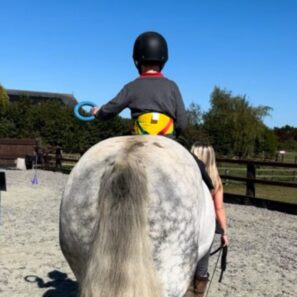
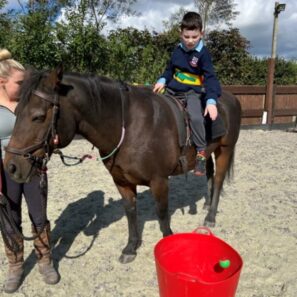
Let's take a little look at how we might use the horse to address typical developmental areas. Gross motor skills riding the horse is a full-body experience. Children have to balance, adjust their posture, and coordinate their movements with the horse's gait. For children who may be delayed in gross motor development, the horse provides a safe but challenging environment to practise these skills.
Sensory integration: The equine environment is incredibly rich in sensory experiences, including vestibular, proprioceptive, tactile, and even olfactory input. For children with sensory processing difficulties, the horse's gait provides rhythmic, repetitive input that really helps with sensory regulation, allowing them to engage in the environment more effectively.
Then, there's social and emotional growth. Engaging with the horse requires understanding and nonverbal cues, establishing trust, and developing empathy. These are critical social-emotional skills that children must learn. Many children are motivated to take care of the horse and this helps to build a sense of responsibility and compassion.
When we think about how EAOT can support a child's development, we must always return to what's most meaningful for that child. Horses provide a unique, natural motivator, a fun and engaging way to practise skills that might otherwise be challenging. Overall, the equine environment is uniquely rich in opportunities to port development in each of these areas.
Let's take a further look at skills development. This very useful but highly complex diagram is known as the pyramid of development. And this particular version was the work of Williams and Schellenberger, two US occupational therapists who are experts on sensory processing. And they went on to develop, actually the alert programme, which you may be familiar with. This illustration outlines the foundational skills at the bottom of the pyramid. And the skills that are supported by those foundational skills are on the tiers above. Once the bottom tiers of the pyramid are adequate, the tiers above can be more efficiently developed. Addressing the skills in this order is known as using the bottom-up approach. This means that the quality of our children's sensory systems, the ones in dark blue, is closely linked to the adequate functioning of their central nervous system and reflexes. That's just below in the red.
You do not have access to this member section
Get accessEAOT 1 Core OT Values
You do not have access to this member section
Get accessEAOT 2 Skill Development in Children and Adults
You do not have access to this member section
Get accessEAOT 3 - Sensory Processing - part I
You do not have access to this member section
Get accessEAOT 4 - Sensory Processing - part II
You do not have access to this member section
Get accessEAOT 5 - Groundwork and the benefits
You do not have access to this member section
Get accessEAOT 6 Why the Equine Environment? - part I
You do not have access to this member section
Get accessEAOT 7 - Why the Equine Environment? - part II
You do not have access to this member section
Get accessEAOT 8 - Case study I - Cri du Chat
You do not have access to this member section
Get accessEAOT 9 - Case study II Autism Spectrum Disorder and Anxiety
You do not have access to this member section
Get accessEAOT 10 - EAOT Session Structure

You do not have access to this member section
Get access