STRENGTHEN YOUR EAS PRACTICE WITH PHYSIOTHERAPY INSIGHTS
Explore Physiotherapy Perspectives in Equine Assisted Services
Equine Assisted Physiotherapy
OCN London L5 Micro-Credentials | Physiotherapy | 18 GLH / CPD Hours | Enrol Anytime
OCN London Micro-Credential
Successful completion of this course leads to the award of an OCN London digital L5 micro-credential recognising focused professional learning in Equine Assisted Physiotherapy (EAPT).
The micro-credential provides verifiable evidence of learning outcomes achieved and supports continuing professional development in health, education, and Equine Assisted Services.
Issued as a secure digital credential, the micro-credential can be shared with employers, educational institutions, and professional networks.
This course forms part of a wider educational pathway developed by Svítání Academy in collaboration with OCN London and aligns with contemporary approaches to modular and lifelong learning.
What This Course Offers
-
Self-Paced Professional Learning
-
Expert-Led Teaching
-
Multilingual Learning Accessibility
-
Applied Clinical Perspectives
-
Lifelong Access to Learning Materials
-
Professional Community and Peer Networking
The course encourages evidence-informed thinking and supports participants in connecting Physiotherapy theory with practical application within Equine Assisted Services.
Meet Your Lecturer
Switch on the automatic subtitles in your preferred language.
Věra Lantelme-Faisan, MSc
Physiotherapist, Equine Assisted Therapy Clinical Specialist, Lecturer
Czech Republic
What Will You Learn
Upon completion of this course, participants will be able to:
- Explain core Physiotherapy principles relevant to Equine Assisted Therapy (EAT).
- Understand the therapeutic effects of equine movement on posture, balance, motor control, and functional performance.
- Recognise physical, sensory, neuromuscular, and developmental factors that influence participation in EAT.
- Apply physiotherapy-informed observation and clinical reasoning within EAT sessions.
- Adapt positioning, activities, and environmental factors to support individual therapeutic goals.
- Identify situations that require referral to a physiotherapist or another healthcare professional.
- Demonstrate increased awareness of safety considerations, precautions, contraindications, and professional boundaries within EAT practice.
- Understand how physiotherapy principles can contribute to evidence-informed treatment planning and outcome measurement in EAT.
Chapters
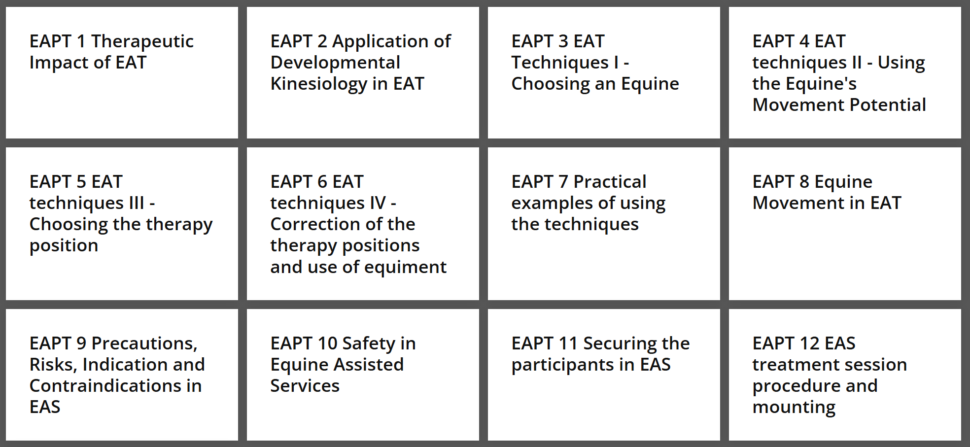
Read a chapter here.
What our learners say
Academic and Professional Context
This course was developed from content originally delivered in the OCN London-accredited L5 Certificate for Equine Assisted Therapy Clinical Specialist (EATCS) programme and has been adapted into a focused professional learning module for learners seeking a deeper understanding of Physiotherapy perspectives within Equine Assisted Services.
Assessment and Verification
Learning is supported through structured educational content, reflective activities, and knowledge review components designed to reinforce understanding of key concepts and their application within practice.
How does the course work?
- No requirements or prerequisites needed.
- E-learning: 12 lessons. You'll receive a username and password to access our online study platform, allowing you to study at your own pace.
- Support: Continuous support is available via email.
- Receive an OCN London L5 digital micro-credentials upon successful completion of the course, together with continued access to course materials and future updates.
Do you want to learn more? Look at our Core Principles of EAS, L5 Equine Assisted Therapy Clinical Specialist or Equine Assisted Learning Practitioner qualifications or Equine Assisted Occupational Therapy online courses.
Registration
OCN London L5 Micro-Credentials | Physiotherapy | 18 GLH / CPD Hours | Enrol Anytime
Please note that registration, invoicing, and payment processing for this course are administered by EAS Global Academy s.r.o. Once your registration is complete, all course-related communication, learning materials, support, and educational activities will continue to be provided directly by Svítání Academy of EAS.
NOTE: If issuing for your company and do not have a company ID, write in the line of "Company ID*" these numbers: 12345
GDPR Compliance:
The organizer will retain your personal data, including your name, email address, and telephone number, for communication purposes until you submit a written request for removal.
Recordings and Publication
By registering and paying for any of our educational events (including courses, webinars, or workshops), you acknowledge and consent that photos and video recordings may be taken during the event. These materials may be used for future reference, educational purposes, and promotional activities.
FAQ
Who is this microcredential designed for?
How does this microcredential support professional practice?
What knowledge and skills will learners gain?
How does this course contribute to interdisciplinary collaboration?
Why is physiotherapy knowledge important in EAS??
Svitani Academy is an accredited OCN London Centre delivering professional qualifications.
We collaborate with international experts and maintain strong links with HETI – The Federation of Horses in Education and Therapy International AISBL, supporting quality and professional standards within the global EAS community.
STRENGTHEN YOUR EAS PRACTICE WITH PHYSIOTHERAPY INSIGHTS