
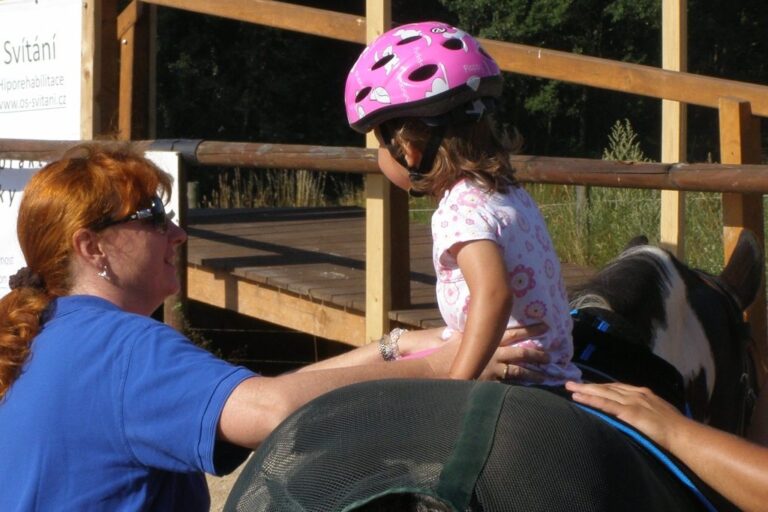
INTRODUCTION TO EQUINE ASSISTED THERAPY FOR BABIES
Equine Assisted Therapy (EAT) offers a unique therapeutic approach for babies, utilising the rhythmic movement of the equine to support motor, sensory, and neurological development. Unlike traditional rehabilitation in clinical settings, EAT integrates natural movement patterns, multisensory stimulation, and motivation-driven interaction in an outdoor environment.
1.1 What is Equine Assisted Therapy (EAT) and How Does It Differ from Other Approaches?
EAT is a specialised intervention that uses equine movement to promote motor, sensory, neurological, and psychological development. For babies, EAT provides gentle stimulation that improves postural control, balance, and sensory integration.
Key Features of EAT:
- Three-dimensional, repetitive, and rhythmic movement mimicking human locomotion.
- A multisensory environment that combines movement, interaction with the equine, and natural stimuli.
- Motivation-driven engagement through interaction with the equine.
Objectives of EAT for Babies:
- Stimulate ideal movement patterns and postural reactions.
- Improve balance, coordination, and deep stabilisation.
- Support sensory integration through vestibular, proprioceptive, visual, audio, olfactory and tactile input.
- Encourage neuroplasticity to enhance motor-sensory connections.
- Promote respiratory and visceral function.
- Foster emotional security, self-awareness, and early communication skills.
- EAT complements other therapies, particularly for children who may not respond well to traditional rehabilitation methods.
1.2 Perspective of the Czech Neurorehabilitation Approach on Psychomotor Development
The Czech neurorehabilitation approach views motor development as a complex interaction between biomechanics, neurophysiology, and sensory input. It recognises that babies experience rapid changes in motor skills, sensory perception, and neurological maturation. This period is critical for establishing ideal movement patterns, sensory integration, cognitive development, and early social communication.
Key Principles:
- CNS Immaturity: The central nervous system (CNS) is immature at birth and continues maturing until approximately six years of age.
- CNS Maturation Processes: Involves myelination, synaptogenesis, and reorganisation of neural pathways.
- Sensory-Driven Motor Development: Motor development relies on appropriate sensory inputs to form and refine movement patterns.
- Genetically Determined Motor Programs: Movement patterns follow species-specific motor programs that are modified and enhanced by sensory experiences.
- Progressive Motor Development: Postural and locomotor functions develop gradually throughout the ontogenetic process.
- Biomechanical & Neurophysiological Coordination: Effective motor control requires integrating biomechanical principles with neurophysiological processes.
- Assessment of Psychomotor Development: The quality and quantity of movement help determine whether motor development is physiological or pathological.
In clinical practice, babies do not learn isolated skills, such as lifting their head, rolling over, crawling, or walking, separately. Instead, movement patterns emerge gradually as the CNS matures, responding to appropriate sensory input. The baby’s internal and external environment, including cultural influences, affects both the timing and the quality of motor development.
1.3 EAT Principles for Babies
EAT must be adapted to the baby’s developmental stage, clinical presentation, and sensory-motor needs.
Therapy Considerations:
- Short Attention Spans: Sessions should be brief and engaging to maintain focus.
- High Sensory Receptivity: Babies are highly receptive to sensory input, making sensory integration a core aspect of therapy.
- Peak Neuroplasticity: Rapid formation of neural connections supports motor learning.
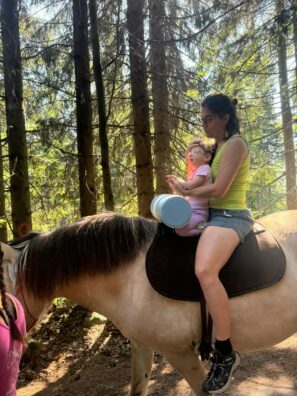
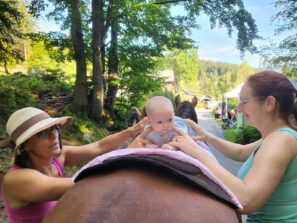
- Caregiver Involvement: Active caregiver participation and co-regulation are essential for effective therapy.
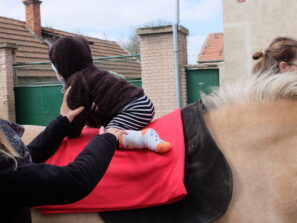
- Safety is paramount when working with this age group: the youngest clients demand the highest level of precaution, and there is no room for error in therapeutic handling, positioning, or equine selection.
1.4 Benefits of EAT for Babies
Supporting Neuroplasticity and Motor Learning:
- EAT promotes ideal motor responses and prevents abnormal patterns.
- The equine’s rhythmic, repetitive movement enhances sensory-motor coordination and motor planning.
Complementing Other Therapy Approaches:
- EAT enhances physiotherapy, occupational therapy, and speech therapy.
- Introduces dynamic, whole-body movement patterns challenging to replicate in clinical settings.
Engaging Natural Therapy Environment:
- Outdoor settings provide rich sensory experiences (e.g., wind, sunlight, sounds, textures).
- The natural environment supports emotional well-being and motivation.
Caregiver Involvement and Motivation:
- Caregivers are highly motivated to participate and actively support therapy goals.
- Early intervention enables caregivers to make a positive contribution before long-term patterns become established.
Easier Handling for Therapists:
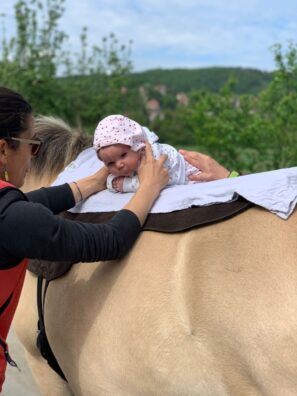
- Babies are small and easy to position, allowing therapeutic flexibility.
- Sessions are less physically demanding than working with older children.
A Natural and Engaging Approach:
- EAT offers a less stressful and more motivating experience compared to clinic-based exercises.
- The equine acts as an intrinsic motivator, encouraging active participation.
1.5 How EAT Supports Movement Development
Activation of Ideal Movement Patterns:
- The equine’s rhythmic, three-dimensional impulses simulate human locomotion.
- Natural activation of postural muscles supports control, balance, and coordination.
- Repetitive movement exposure reinforces ideal motor patterns.
Promotion of Neuroplasticity:
- The baby’s highly plastic brain rapidly adapts to coordinated movement and sensory input.
- Consistent, structured sessions strengthen neural connections essential for motor planning and coordination.
- Enhanced brain reorganisation and integration of new movement patterns.
Role of the Limbic System in Motor Learning:
- The limbic system, responsible for emotional processing and memory, enhances engagement and learning.
- Positive movement experiences strengthen neuromuscular responses and procedural memory.
- Emotional security and enjoyment encourage active participation and sensory processing efficiency.
Postural Control and Motor Learning:
- EAT stimulates deep stabilisation systems (DSS), enhancing core stability, pelvic alignment, and postural adjustments.
- Babies with hypotonia benefit from core activation, while those with spasticity experience reduced muscle hypertonicity.
- Movement across multiple planes (anterior-posterior, lateral, forward-backward) engages neuromotor pathways for refined coordination and transitions.
1.6 How Therapy for Babies Differs from Work with Older Children
Adaptations for Babies:
- Shorter Therapy Sessions: Sessions should adapt to the baby’s mood and regulation needs (Recommended length: 5–15 minutes).
- Non-Verbal Communication and Emotional Cues: Babies communicate through facial expressions, body tension, and engagement levels.
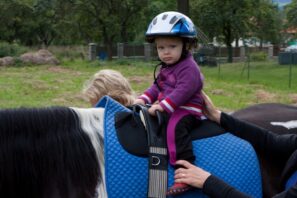
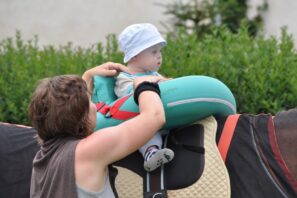
- Active Caregiver Involvement: Caregivers play a key role in co-regulation and positioning.
- Emotional Experience and Motivation: Positive experiences with the equine promote engagement and motivation.
You do not have access to this member section
Get accessCHAPTER 2: SENSORY INTEGRATION IN EAT
You do not have access to this member section
Get accessCHAPTER 3: PSYCHOMOTOR DEVELOPMENT
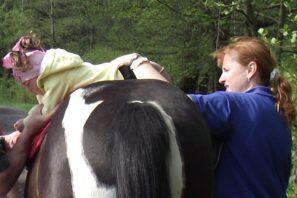
You do not have access to this member section
Get accessCHAPTER 4: REFLEX INTEGRATION AND POSTURAL RESPONSES IN EAT
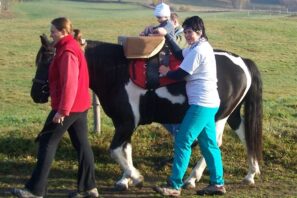
You do not have access to this member section
Get accessCHAPTER 5: THE IMPACT OF EAT ON BALANCE, COORDINATION, AND POSTURAL CONTROL
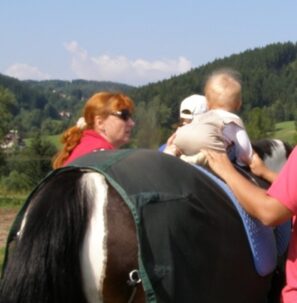
You do not have access to this member section
Get accessCHAPTER 6: EMOTIONAL CONNECTION AND SOCIAL INTERACTION
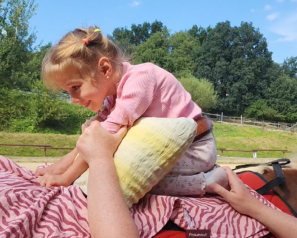
You do not have access to this member section
Get accessCHAPTER 7: SAFETY CONSIDERATIONS IN EAT FOR BABIES
You do not have access to this member section
Get accessCHAPTER 8: SELECTING AND PREPARING EQUINES TO EAT WITH BABIES
You do not have access to this member section
Get accessCHAPTER 9: THERAPEUTIC METHODS AND TECHNIQUES IN EAT FOR BABIES
You do not have access to this member section
Get accessCHAPTER 10: STRUCTURE AND MANAGEMENT OF THERAPY SESSIONS
You do not have access to this member section
Get accessCHAPTER 11: COLLABORATION WITH CAREGIVERS AND MULTIDISCIPLINARY TEAMS
You do not have access to this member section
Get access