
Skill Development in Children and Adults
In this chapter, we explore skill development across various life stages, particularly focusing on children and how Equine-Assisted Occupational Therapy (EAOT) supports developmental milestones. EAOT provides a motivating, sensory-rich environment that promotes growth in motor, sensory processing, emotional regulation, and social skills. By engaging with the horse in meaningful and functional activities, children can develop core stability, coordination, and empathy, among other skills. This chapter also delves into the pyramid of development, explaining how foundational sensory and motor skills create the base for higher-level functions. Through EAOT, therapists can apply a client-centred approach to address gaps in development and foster skills that carry over into daily life.
Switch on the subtitles in your language
Welcome to the OT module of the equine-assisted therapy course for physical, OT and speech therapy. This is chapter two, and chapter two is based on skill development in children and adults. In this chapter, we're going to dive into the different aspects of skill development in children and how equine-assisted OT can support these developmental milestones.
OT is all about helping children acquire the skills they need to participate in meaningful activities, whether that's playing, socialising, learning or performing daily routines. In equine-assisted OT, the equine environment offers a hugely rich context for developing these skills in a way that's really engaging and inherently motivating, which is a magical combination for the children.
As we begin to think about the unique contributions of equine-assisted OT, it's really important to revisit what we know about typical child development. Occupational therapy, at its core, is about helping clients, especially children, progress through the developmental milestones that allow them to function successfully in their environments. In children, development occurs through a combination of gross motor skills, fine motor skills, cognitive development, and social-emotional growth. The horse's movement plays a hugely significant role in supporting many of these aspects. Riding a horse stimulates the development of motor skills, especially core stability and balance.
The movement of the horse mimics the rhythm of human walking, which is highly beneficial for children who need extra support in developing core coordination and gait. This chart that we can see here is one of the many readily available developmental charts that highlight the sequence of skills development in children across the commonly recognised five domains of development. Developmental assessments highlight where the child is on each of these elements and this can then be used to inform treatment.
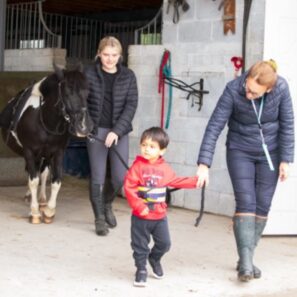
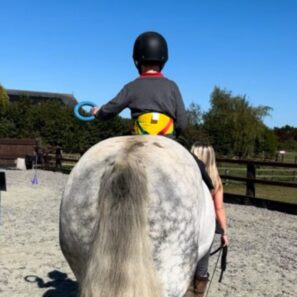
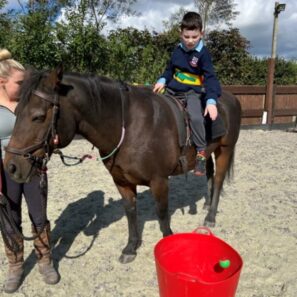
Let's take a little look at how we might use the horse to address typical developmental areas. Gross motor skills riding the horse is a full-body experience. Children have to balance, adjust their posture, and coordinate their movements with the horse's gait. For children who may be delayed in gross motor development, the horse provides a safe but challenging environment to practise these skills.
Sensory integration: The equine environment is incredibly rich in sensory experiences, including vestibular, proprioceptive, tactile, and even olfactory input. For children with sensory processing difficulties, the horse's gait provides rhythmic, repetitive input that really helps with sensory regulation, allowing them to engage in the environment more effectively.
Then, there's social and emotional growth. Engaging with the horse requires understanding and nonverbal cues, establishing trust, and developing empathy. These are critical social-emotional skills that children must learn. Many children are motivated to take care of the horse and this helps to build a sense of responsibility and compassion.
When we think about how EAOT can support a child's development, we must always return to what's most meaningful for that child. Horses provide a unique, natural motivator, a fun and engaging way to practise skills that might otherwise be challenging. Overall, the equine environment is uniquely rich in opportunities to port development in each of these areas.
Let's take a further look at skills development. This very useful but highly complex diagram is known as the pyramid of development. And this particular version was the work of Williams and Schellenberger, two US occupational therapists who are experts on sensory processing. And they went on to develop, actually the alert programme, which you may be familiar with. This illustration outlines the foundational skills at the bottom of the pyramid. And the skills that are supported by those foundational skills are on the tiers above. Once the bottom tiers of the pyramid are adequate, the tiers above can be more efficiently developed. Addressing the skills in this order is known as using the bottom-up approach. This means that the quality of our children's sensory systems, the ones in dark blue, is closely linked to the adequate functioning of their central nervous system and reflexes. That's just below in the red.
And our children's ability to plan their own movements uses both the left and right sides as a body efficiently. Along with other sensory motor development characteristics, all in the green tier depend on the quality of their vision, touch, proprioception and other sensory systems, and that's the blue tier. Their ability to use their eyes and hands in a coordinated manner, their ability to adjust their posture for balance and other perceptual motor development characteristics in the yellow tier depend on their ability to plan their own movements and other sensory-motor development characteristics in the green tier.
When you stabilise the foundation and work upwards, starting with sensory processing and then motor skills, the levels above, more often than not, tend to develop without huge support. As OTs, we tend to need to look at the cause of a child's inability to dress themselves. Are they tactile issues or body scheme problems, or where on the pyramid is that issue arising from? And if we can support those underlying problems, then we can support skills acquisition at, you know, a higher level.
And in my experience, a lot of the time, children who come to us have what I would call splinter skills, and they've tried to develop skills high up the triangle, but they have gaps and a lack of skills from below. And so in my experience, a lot of the issues with upper levels of skill acquisition is related to gaps in sensory processing. And again, we're on a winner.
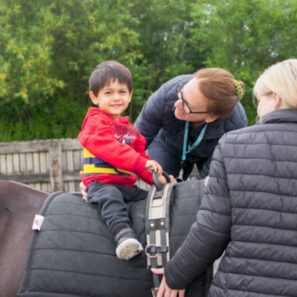
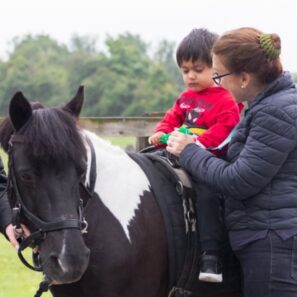
In an equine environment, it is hugely sensory and supports the development from the bottom-up approach. Let's take another look at the areas of skill development in children. Motor skill development is a major focus of paediatric OT and equine-assisted OT. Both gross motor skills and fine motor skills are addressed through engaging activities with the horse. So for gross motor skills, activities like mounted exercises help children develop balance, coordination, core stability, and the horse's movement naturally challenges them to maintain postural control and improve their core strength and balance. And this is hugely beneficial for children with motor coordination challenges, like those with cerebral palsy or developmental coordination disorder or low tone in Down syndrome, for example.
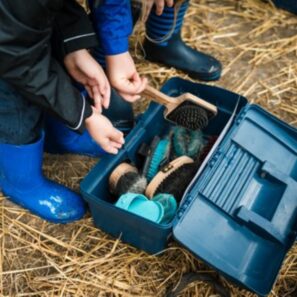
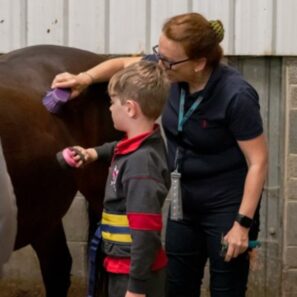
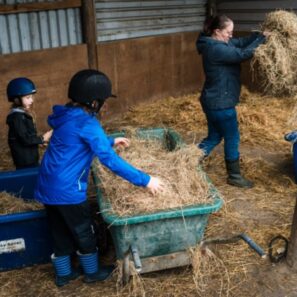
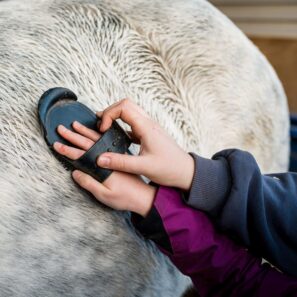
Fine motor skills: When children participate in grooming, the horse adjusts the tack. They work on fine motor skills control. Grooming requires the use of different tools like brushes and combs and this helps children develop their grip strength and hand-eye coordination. Sweeping using a wheelbarrow and the reins all involve practising bilateral coordination using both hands together effectively. One of the unique advantages of the equine environment is that it makes motor activities fun and motivating. And a child who might be hesitant to participate in traditional therapy exercises often feels much more excited and engaged when those exercises are framed as tasks that help to care for the horse and connect with it during their sessions.
The next area, sensory processing, is the foundation for many of the skills that we work with in children. Equine-assisted OT is an immersive sensory experience that provides huge inputs that can be used to help children better organise their responses to sensory stimuli. So, we have vestibular and proprioceptive input. When they're on a horse, they receive vestibular input from the movement. And the rhythmic gait of the horse helps to improve balance and postural control, allowing them to experience a natural and continuous form of movement input. Proprioceptive input comes from the need to adjust their body while riding and, you know, from physically interacting with the horse by lifting brushes, adjusting the saddle, or even leading the horse.
These forms of input help children to better develop body awareness and coordination. Tactile experiences groom and the horse offers a huge range of tactile experiences, from the texture of the mane to the feeling of the coat and even the firm, warm muscle underneath the skin. For children with tactile defensiveness, these grooming activities are, you know, a really good chance to slowly and comfortably increase their tolerance for touch, helping them to become less reactive to the tactical early input in other areas of their lives. So through these activities, equine-assisted it becomes a natural form of sensory integration, helping children make sense of the information in the real-world context that encourages exploration and engagement.
Many of the children that we work with struggle with emotional regulation. They may have difficulty managing frustration, anxiety, sensory overload, and then, of course, that naturally impacts their ability to engage in activities and form positive relationships. But the equine environment provides multiple opportunities to develop emotional regulation.
There's co-regulation with the horse. Horses are highly attuned to human emotions, and they respond to our energy, body language, and tone. That creates an opportunity for co-regulation. A child who's dysregulated might notice that the horse becomes skittish or less responsive, prompting them to take a step back and work on calming themselves. You know, the horse serves as a non-judgmental mirror, reflecting the child's internal state and helping them to practise regulating their emotions. There's the rhythmic movement, and the horse's movement offers repetitive rhythmic input that calms the nervous system. So, riding at walk is similar to the soothing motion of being rocked, and it can be incredibly calming for children who are in a heightened state of arousal. And this movement helps children reach a state of regulation where they can focus, learn and engage in activities. This is one of the cheats moments.
After a lot of intense sensory input in the arena, I will often take a child out for walk in the field. And it's about that regular rhythmic walking where you are allowing the sensory systems to absorb all the work that you've just done, allowing them to regulate predictable routines. Horses thrive on routine, and using consistent session structures helps the children anticipate what's coming next. So, predictability is hugely important, especially for children with autism or anxiety. And it helps to reduce uncertainty and provides them with a sense of control. Having a structured, predictable sequence, like greeting the horse, grooming, then leading or riding, you know, it creates an environment where children feel safe and they're better able to practise emotional regulation.
Social skills. Social skills development is an essential part of helping children participate in their communities. Whether it's at school, with peers or within their families. The equine environment offers unique opportunities for children to practise and improve their social skills.
Nonverbal communication. Horses communicate primarily through body language, and working with them requires the client to do the same. You know, children learn how to use clear, consistent body language to guide the horse and how to read the horse's nonverbal cues to understand its needs and reactions. And this is an excellent way for children to develop better awareness of nonverbal communities. Communication and this is, to be honest, a critical skill for interacting with people.
Building empathy. You know, caring for a horse provides an opportunity for children to practise empathy. They learn to notice what the horse needs, whether it's food, water, or a gentle touch, and they respond. You know, children who struggle with understanding other people's perspectives, the bond that they form with the horse can be an important step in learning to consider the feelings of others.
Turn-taking and collaboration. You know, many equine activities are done in peers or small groups, which helps children practise taking turns and collaborating. Whether it's taking turns leading the horse or working together to groom it, these activities help children to build the skills they need to interact positively with peers. For children with social anxiety, the presence of the horse can help lower anxiety levels, making social interactions feel much safer and more manageable, and therefore, they can benefit more from them.
Let's have a look at the OT process, which you all know, in the equine environment, you know, we have ultimate support to address multiple areas of development simultaneously. When working out treatment priorities, we always follow the steps of we have a comprehensive assessment and you know, we gather input from the family members, observe the child in different environments, use standardised assessments to understand their needs, and we identify specific areas of delay or challenge, and then we set meaningful goals. Treatment priorities are always based on what's meaningful to the client and their family. And in EAOT, the child's interests guide the activities we do.
For example, if a child loves grooming, we can use this activity to work on sensory processing or bilateral coordination. Matching intervention to needs once we have set the treatment priorities, we need to work out how best to use the equine environment to address those needs.
And this is where clinical reasoning really comes into play. So, for a child needing vestibular input, mounted activities are obviously ideal. For a child needing to build confidence or working on sensory defensiveness, groundwork activities may be more appropriate.
Building on strengths. Each child comes with their own strengths, and our goal is to build on these strengths while addressing areas of need in the equine environment, we might use a child's natural love of animals to motivate them to participate in much more challenging activities than they might elsewhere.
Safety and adaptability. Throughout the process, we must always ensure that activities are safe for both the child and the horse. If a child is fearful of riding, we don't force it. We adapt, perhaps by starting with leading or watching from a safe distance. And it is important that we are adaptable, using clinical reasoning approach to adjust what we're doing based on the child's responses.
It's really important for us as OTs that the skills we teach them in sessions translate to their everyday lives. And I have never found that there's a problem with this. It is a process that happens so naturally for the children, you know, so the children practise things in the equine environment and then we want them to improve their participation in daily activities as a result.
And, you know, the goal is to take the skills learned, like, you know, emotional regulation, coordination, communication, and help them to apply these skills in other environments, like at home or, in school or in the community. And examples might be a child who learns to tolerate tactile input through grooming, may become more comfortable with dressing and bathing at home in the morning times.
Or a child who builds core strength while riding might develop better posture and stamina for sitting at their desk in school. Real-world application of OT goals, equine OT activities are inherently functional. Leading a horse is similar to walking with a family member, maintaining pace and direction. Grooming practises the fine motor skills that can be applied to self-care activities. Mounted activities can develop core strength. That's essential for everyday activities like sitting at the table for meals or for playing on the floor.
Parental involvement, I think, is really important. It is a key to ensuring that skills carry over into daily routines. Prents can observe the strategies we use to help their child to regulate emotions or develop motor skills, and can then implement similar approaches at home. For instance, like if brushing the horse helps a child calm down, parents can use similar deep-pressure activities like brushing the child's arm or back to help them with regulation at home.
Up to now, in this section, we've been talking mostly about children, and this slide outlines the overarching areas that we address in the assessment and treatment in planning for both children and adults. As I'm aware, a lot of you are dealing with adults in your clinical practice. As you can see, they're both hugely similar, you know, as the key as occupational therapists, is to look at the developmental triangle and to work out where the foundations are weak and to focus on strengthening those underlying skills.
Just as out of interest, this is a video from a colleague of mine in Greece. And here, we see a man with MS on his first and 6th time in an equine-assisted physiotherapy session. And the difference speaks for itself. So for what we, the work that we can do does across all ages and abilities. Let me play this for you. So, the results speak for themselves about how his motor abilities have improved over the course of just six sessions.
This is the summary of chapter two, skill development. In this chapter, we looked at how equine-assisted OT can support the development of key skills in children and we've mentioned motor skills, sensory processing, emotional regulation and social skills. The horse provides a unique, dynamic environment in which children and adults can practise these skills in a meaningful and engaging way. The goal is always to use their strengths and interests as the foundation for building skills that will translate into greater participation and independence in their everyday lives.
As we're not all paediatric OTs, I think it would be good to take a moment to reflect on skill development across life stages and to note the areas that are the focus of intervention. Can you think of a client and the areas you are focusing on in intervention, are they any different to the developmental areas we have discussed for children?

You do not have access to this member section
Get accessEAOT 1 Core OT Values
You do not have access to this member section
Get accessEAOT 2 Skill Development in Children and Adults
You do not have access to this member section
Get accessEAOT 3 - Sensory Processing - part I
You do not have access to this member section
Get accessEAOT 4 - Sensory Processing - part II
You do not have access to this member section
Get accessEAOT 5 - Groundwork and the benefits
You do not have access to this member section
Get accessEAOT 6 Why the Equine Environment? - part I
You do not have access to this member section
Get accessEAOT 7 - Why the Equine Environment? - part II
You do not have access to this member section
Get accessEAOT 8 - Case study I - Cri du Chat
You do not have access to this member section
Get accessEAOT 9 - Case study II Autism Spectrum Disorder and Anxiety
You do not have access to this member section
Get accessEAOT 10 - EAOT Session Structure

You do not have access to this member section
Get access