Equine Assisted Therapy Clinical Specialist (EATCS) Course
Entry Requirements and Course Guidelines
2026
We are delighted that you have chosen to join the OCNLR Level 5 Certificate for Equine Assisted Therapy Clinical Specialist (EATCS).
This programme is based on European and North American treatment standards, clinical reasoning and equine welfare principles. It is delivered by experienced international lecturers committed to supporting your professional development throughout the course.
To maintain high professional and ethical standards, all learners are expected to meet the requirements and deadlines outlined below.
Before the Programme Begins
Before joining the programme, learners must complete the following:
1. Submit Proof of Professional Qualification
Provide a copy of your professional diploma - a physiotherapist, occupational therapist, speech and language therapist, or psychomotor therapist
2. Submit a copy of the Core Principle of EAS course certificate
3. Complete the Entry Self-Evaluation Quiz
If additional preparation is needed, learners are responsible for obtaining the required knowledge on their own. Open the quiz here.
4. Submit an Equine Handling Video
- Putting a halter on an equine
- Tying a safety knot
- Brushing the equine over the whole body
- Cleaning the hooves
- Putting on the bridle and saddle
- Leading the equine independently in an arena or paddock for at least one full round with a minimum diameter of 50 metres, including two halts and walking on again
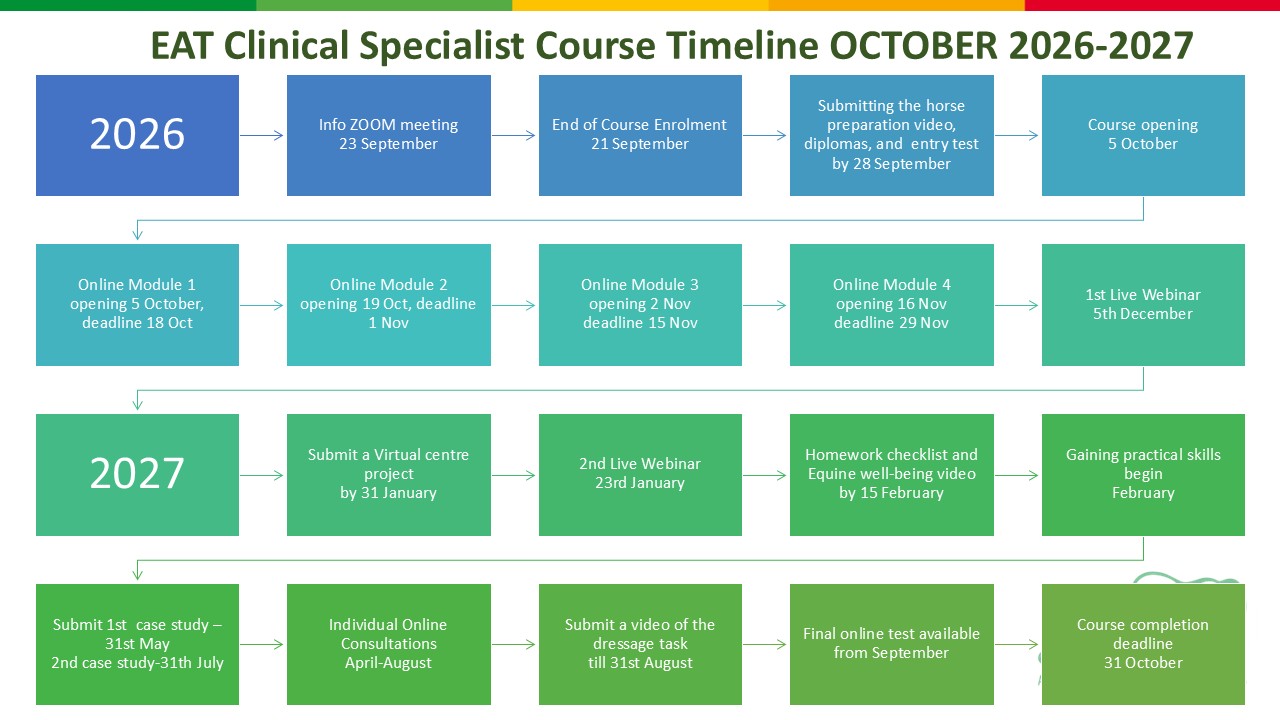
The deadline for submitting the entry requirements is 28 September 2026.
Submitting Your Work for the EATCS Course
Throughout the course, you’ll upload your videos, files, and assignments, and we’ll use Google Drive to keep them all tidy and accessible.
Here is how to set it up:
- Please create a Google Drive folder as soon as possible, name it 2026-EATCS course – Your Full Name, and share it with me at students@hipoterapie-kurzy.com. Make sure the access is open so that all lecturers can view your work.
- Upload all your materials to this folder. Each time you add something new, please share the link to your document with me at students@hipoterapie-kurzy.com so I know it’s there.
- When naming your folders and documents, please always use this format: 2026-EATCS course – Your Full Name – Document Title
- All submissions must go through your Google Drive folder only. Any work submitted via email or social media may be lost, so we cannot accept submissions in this manner.
As university graduates, we trust you are familiar with the academic standards expected in your submissions for an L5 qualification.
Course structure and deadlines
Regular participation and timely submission of tasks are essential for the successful completion of the programme. Learners experiencing genuine difficulties are encouraged to communicate with the team early and may apply for an extension in accordance with the extension policy, available here.
Course requirements
During the course, you will be required to:
- Submit two case studies and two assessment videos demonstrating your practical skills.
- Submit a video of a dressage test. If you are not already an active rider, you must begin your training immediately at your own time and expense.
- Complete 40 hours of hands-on practice in a centre of your choice. Practice begins in February 2026, and you are responsible for securing your placement in advance.
- Submit a Virtual EAS centre project.
- Attend two live online webinars. Attendance is mandatory; missing a live event will result in an interruption to your studies without financial reimbursement.
Please note that photos and videos may be taken during live course events for educational and promotional purposes.
Non-negotiable standards
We expect every student to uphold the highest standards of professional conduct and equine welfare, in line with the ethical guidelines of HETI. Any breach of the five domains of equine welfare observed in your submitted materials will prevent you from continuing until the issue is resolved.
If you face genuine difficulties, you may apply for an extension in accordance with the extension rules.
Digital and Practical Requirements
To succeed in this programme, learners should feel comfortable with online learning and basic digital tasks, as much of the course is delivered through e-learning, written submissions, online forms and video evidence.
Learners are expected to have basic computer skills, including the ability to:
* use email confidently
* create, edit and save documents
* complete project assignments using Word or PowerPoint
* convert documents into PDF format for submission
* complete Google Forms used for quizzes, tasks and assessments
* record videos using a phone or camera
* download, save and organise files
* upload documents and videos to Google Drive
* access and use shared folders and links
* participate in live online sessions using Zoom or similar platforms
* learners should be comfortable using a browser and YouTube translation tools if needed
As the programme includes practical tasks with equines and session-based activities, learners should be physically able and personally prepared to participate safely and to manage the demands of a 1-year qualification pathway.
This course requires commitment, organisation and regular engagement.
Learners should be prepared to meet deadlines, complete practical evidence and remain motivated throughout the programme.
Withdraval Options
If you decide not to continue with the programme or feel unable to meet the course requirements, you may request withdrawal by email before 28 September 2026. In such cases, the course fee will be refunded minus the €200 administration fee.
We look forward to welcoming motivated, hard-working therapists committed to advancing their skills and knowledge in this exceptional course. Together, we will establish a solid foundation for your future work in Equine-Assisted Therapy.