A Horse Walking for Fifteen Minutes. How Hard Can That Be?
Whenever we were looking for a new horse for our Equine Assisted Services (EAS) programme, we had one rule: never mention EAS in the advertisement. Why? Because as soon as we mentioned it, we started receiving some very strange offers. Older horses, horses with physical limitations, horses that were no longer suitable for competition or riding. Their owners genuinely believed they could have a nice, easy job in our field.
Instead, we described exactly what we needed: the horse’s conformation, physical abilities, temperament, movement quality and mental characteristics required for our particular work.
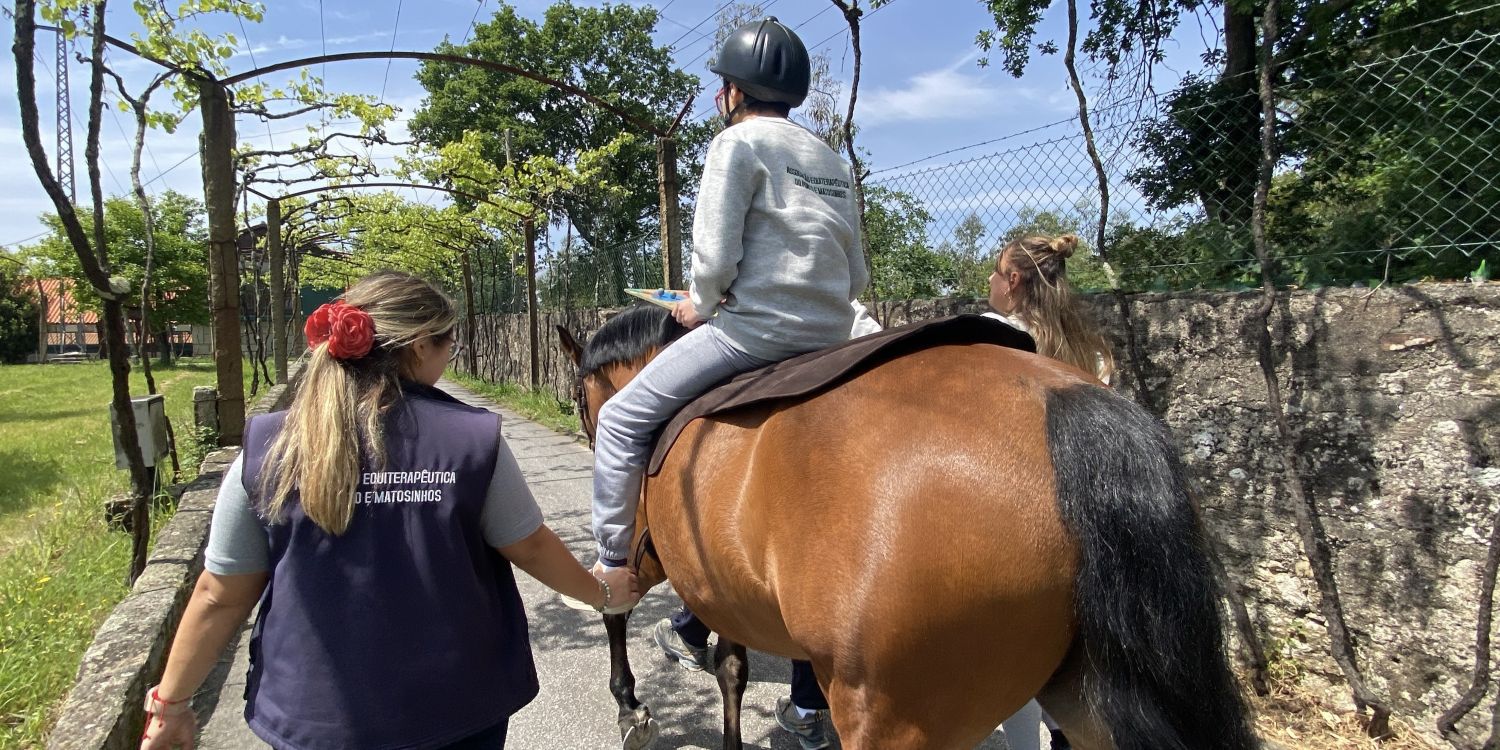
I still encounter this attitude, sometimes even among experienced horse people or students considering a career in Equine Assisted Services. Someone tells me, “I have a lovely horse. He’s very calm, loves people, and we’re not competing any more. I think he’d be perfect for therapy.” Perhaps he would, but I usually suggest a little experiment before making that decision.
Try this with your horse for one week
Imagine taking your horse out of the paddock three times a day. Bring him into the stable, prepare him, put on his equipment, take him out, ask him to stand quietly for ten minutes, then bring him back. Repeat the same routine several times throughout the day, for a whole week.
Bring your horse into the stable several times a day, prepare him, put on all his equipment, take him out, ask him to stand quietly for ten minutes, then bring him back.
Now imagine that every time he comes out, different people are waiting for him. They approach, talk, touch him, want to stand beside him and take photographs. Some move unpredictably, some are noisy, others are very quiet. The atmosphere changes constantly, and your horse is expected to remain calm and cooperative throughout.
Of course, I would never suggest deliberately overwhelming an equine to prove a point. Any practical assessment must respect his responses and stop if he becomes uncomfortable. But think about what this routine would mean for your horse, especially if he has never experienced anything similar.
After several days, does he still come towards you when you enter the paddock? Is he curious and relaxed when you bring out the equipment? Does he seem comfortable with the repeated activity, or is he beginning to avoid you? These observations tell us much more than the fact that a horse stands quietly when his owner is nearby.
Fifteen minutes of walking. How difficult can that be?
Let me give you another example from Equine Assisted Physiotherapy. We may ask a horse to walk for 15–20 minutes at a consistently slow speed and regular rhythm, sometimes almost entirely in straight lines, while carrying a client with impaired balance or an asymmetrical posture.
Think about what we are asking. No spontaneous changes of pace, no opportunity to trot or canter, no variation in the task. The quality and regularity of the horse’s movement are essential to the physiotherapy intervention. Even a well-trained sport horse is rarely asked to perform such monotonous work continuously. During ordinary training, the rider changes direction, pace, gait and exercises, giving the horse opportunities to vary his movement.
Now add the physical demands of carrying a client in different therapeutic positions, sometimes someone who cannot adapt naturally to the horse’s movement. Depending on the programme, a horse may participate in three or four sessions in a day. Each involves preparation, transitions, people and expectations. Whether that workload is appropriate depends on the individual horse, the activities and sufficient opportunities for rest and recovery.
The physical demands can be considerable, but I believe the mental demands are often even more underestimated. And this is something I have encountered throughout my professional practice, particularly when discussing the work with people who have extensive experience with horses but little experience in EAS.
Your calm horse may meet a completely different world
A horse that is relaxed with his owner in a familiar stable may respond quite differently when surrounded by unfamiliar people. In EAS, the environment can change from one session to another. One client may be very quiet, with limited movement and little verbal communication. The next may arrive full of energy, speaking loudly, moving suddenly or struggling to control their movements.
There may be wheelchairs, walking frames, unfamiliar equipment and unexpected noises. People approach from different directions, and several team members may need to work close to the horse at the same time. Even positive attention can become tiring. Everybody loves the horse; everybody wants to touch him, stroke him or take a photograph. But has anybody considered whether the horse wants all that attention?
An equine that stands still is not necessarily comfortable. I have seen horses tolerate situations while showing tension through their expression, posture or behaviour. Recognising these subtle signals is essential because a horse may communicate discomfort long before reacting in a way that people recognise as a problem.
What criteria are we looking for in an ideal therapy equine?
I have worked with wonderful equines of different breeds, ages, sizes and backgrounds. Some were experienced riding horses; others had very different histories. For me, the question has always been whether the individual is physically and mentally suited to the particular activity and willing to engage in it.
A horse may be excellent for Equine Assisted Learning and unsuitable for Equine Assisted Physiotherapy. Another may be comfortable with Therapeutic/Adaptive Riding but find close interaction with several people stressful. Even a suitable horse needs appropriate preparation, conditioning, workload management and a team that understands him.
We need to accept that equines have preferences, just as we do. Some genuinely seem to enjoy particular activities and interactions, while others are much happier doing something different. Their individual preferences deserve consideration alongside their physical abilities and the requirements of the programme.
I would also pay close attention to the horse’s movement, particularly when mounted activities are involved. Clients with intellectual disabilities, for example, may also experience difficulties with balance and coordination. The quality, regularity and balance of the horse’s movement are therefore essential, not only in Equine Assisted Physiotherapy.
So, if you have a lovely, calm horse and are thinking about involving him in Equine Assisted Services, I would want to assess his physical abilities and movement quality, as well as his temperament. How does he respond to the actual work? How does he feel afterwards? And does he still seem happy to participate the next day? These are the questions I would start with.
If you are considering working in Equine Assisted Services, understanding these physical and mental demands is an essential part of your professional education. At SVÍTÁNÍ ACADEMY®, we explore how to assess equine suitability, recognise individual responses and develop programmes that respect both client needs and equine wellbeing.
Věra’s EAS Lens is a space where I share my professional reflections, clinical reasoning, and international experience in Equine Assisted Therapy and Services. Drawing on many years of practice, education, and collaboration across countries and disciplines, I look at EAS through an expert, critical, and ethical lens. This blog is written for professionals, students, and organisations who wish to understand EAS beyond trends and enthusiasm, and to anchor their work in quality, responsibility, and meaningful practice.
Follow my blog on FB, Ins and LinkedIn #VeraEASLens

Enjoyed this article? Download our free e‑book “10 Essential Insights into Equine Assisted Services” and discover practical tips you can start using today.
Would you like more inspiration, ideas, and professional insights? Join our Svítání newsletter and never miss an article, event, or course update.
Curious to deepen your knowledge in Equine Assisted Services? Explore our courses designed by experienced practitioners and start your learning journey with Svítání today.
 Entusiasta, mas sem qualificação nos Serviços Assistidos com Equinos
O entusiasmo não substitui a qualificação. Saiba por que a formação e…
 Intensive Equine Assisted Therapy Clinics: Why a Few Days Can Make a Real Difference
Explore intensive Equine Assisted Therapy clinics for children: short, individually adapted sessions,…
 When a Child Says No to Equine Assisted Therapy | Vera’s EAS Lens
When a familiar child says no to Equine Assisted Therapy, what happens…