Equipment in Equine Assisted Services: When It Supports — and When It Replaces Preparation
The discussion in the previous article about helmets leads to a broader reflection on equipment in Equine Assisted Services. In some settings, additional protective equipment, such as safety vests, is used. This is often done to increase safety, which is understandable. At the same time, it is worth asking whether such equipment always supports the purpose of the session.
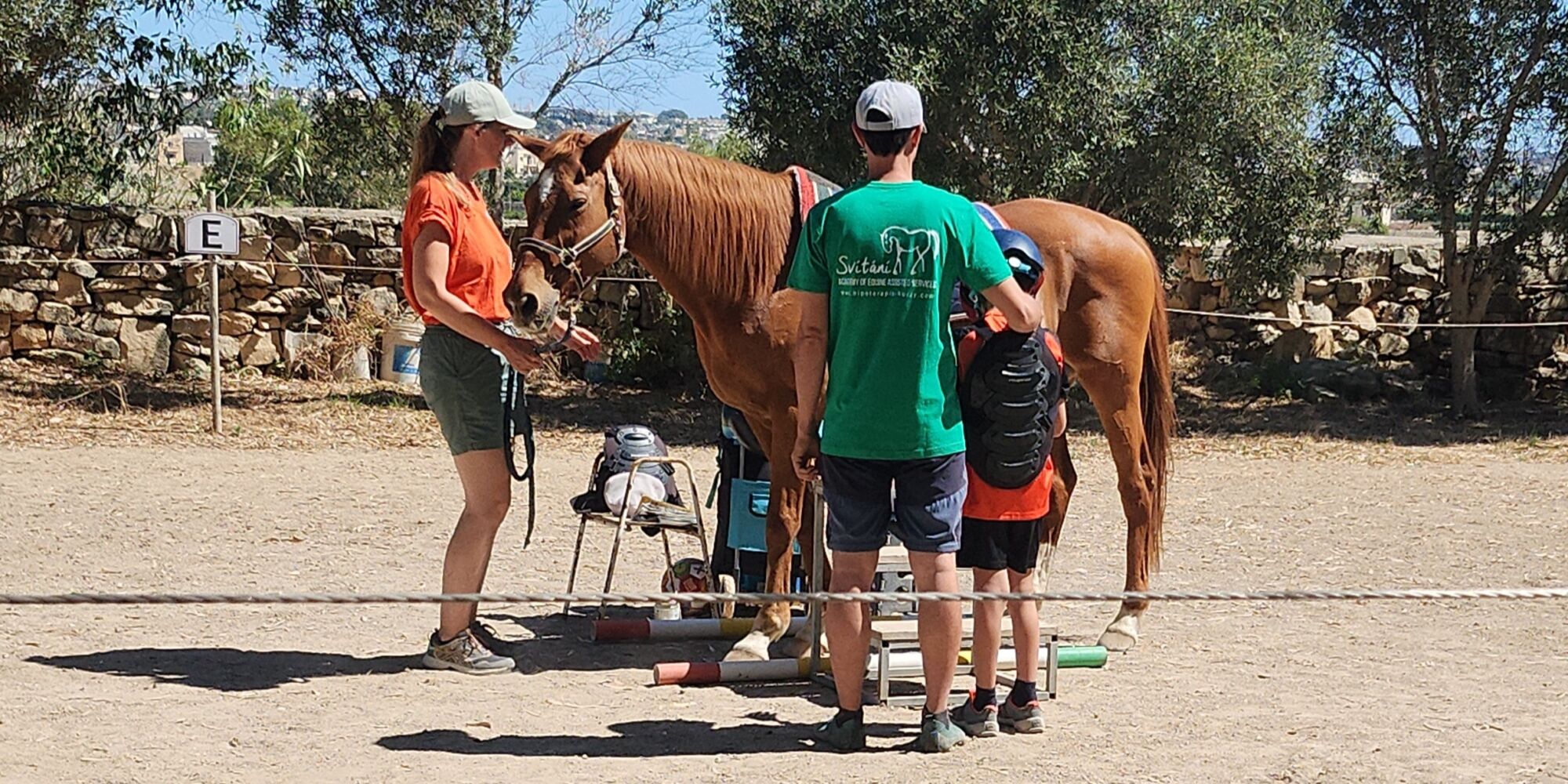
In Equine Assisted Services, the movement of the equine is a central element of the work. The client not only sits on the equine but also experiences movement, rhythm, and continuous sensory input. For this reason, anything that limits the transmission of movement or reduces the client’s ability to respond to it should be carefully considered.
A protective vest, by its nature, stabilises the trunk and restricts movement. While this may be appropriate in certain riding contexts, it can interfere with the desired movement interaction between the client and the equine. The client may feel less, move less, and respond less. This raises a simple but important question: if the vest limits the very experience we are trying to create, does it still serve the session’s purpose?
Are we using equipment because it truly supports the session, or because we are not fully confident in the preparation behind it?
Of course, there are situations where such equipment may be appropriate. When a person rides independently, when the equine is not led, or when working at a higher gait such as trot or canter, the level of risk changes. In these situations, protective equipment may be adequate.
However, in many Equine Assisted Services sessions, the conditions differ. The equine is led, the environment is structured, and the practitioner is present close to the client. In such cases, the use of protective equipment sometimes reflects not the client’s needs but uncertainty in other areas.
This leads to a more fundamental question. Are we using equipment because it truly supports the session, or because we are not fully confident in the preparation behind it? The reliability of the equine, the handler’s experience, and the organisation of the session all play a significant role in safety. If these elements are not well established, equipment may be used as reassurance.
Equine Assisted Services require a high level of preparation. The equine needs to be carefully selected, trained, and reliable. The handler must understand equine behaviour and be familiar with the principles of Equine Assisted Services. The team needs to work in a coordinated and predictable way. This foundation is what creates a safe and meaningful environment for the client.
If we rely on equipment to compensate for a lack of preparation, we risk losing the essence of the work. The quality of Equine Assisted Services does not come from what we add on top, but from how well the entire environment is prepared and managed.
This is not about being for or against protective equipment. It is about understanding its role. Equipment should support the session, not replace the preparation it requires.
Want to build a stronger foundation before working in Equine Assisted Services?
Core Principles of Equine Assisted Services is a 74-hour online foundation programme designed to help you understand professional roles, safety, equine welfare, terminology and the knowledge you need for your next step.
Věra’s EAS Lens is a space where I share my professional reflections, clinical reasoning, and international experience in Equine Assisted Therapy and Services. Drawing on many years of practice, education, and collaboration across countries and disciplines, I look at EAS through an expert, critical, and ethical lens. This blog is written for professionals, students, and organisations who wish to understand EAS beyond trends and enthusiasm, and to anchor their work in quality, responsibility, and meaningful practice.
Follow my blog on FB, Ins and LinkedIn #VeraEASLens

Enjoyed this article? Download our free e‑book “10 Essential Insights into Equine Assisted Services” and discover practical tips you can start using today.
Would you like more inspiration, ideas, and professional insights? Join our Svítání newsletter and never miss an article, event, or course update.
Curious to deepen your knowledge in Equine Assisted Services? Explore our courses designed by experienced practitioners and start your learning journey with Svítání today.
 The Silent Load: Why Therapy Equines Shouldn’t Be Called Therapists
In modern discourse, it’s all too easy to conflate our Equine Assisted…
 Enthusiastic but not yet qualified
Can enthusiasm replace training in Equine Assisted Therapy? A professional reflection on…
 What I Wish I Had Known Before Working in Equine Assisted Services
What should you know before working in Equine Assisted Services? Vera Lantelme-Faisan…